Save 30% on annual bloodwork with your regular priced exam (offer ends March 31). Offer valid at participating locations.  Find a Location

How Long Do Dogs Take to Recover From Spay Surgery?

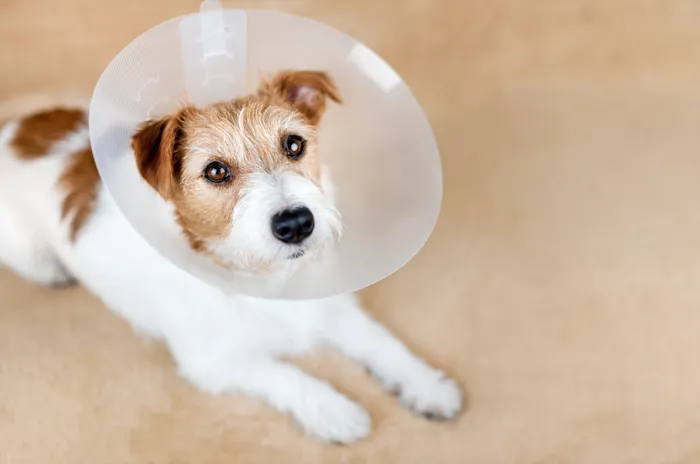
Dog in cone after surgery

Most dogs need 10 to 14 days for the incision to heal, with internal healing continuing for a few weeks after that. If you’re wondering how long dogs take to recover from spay surgery, two weeks of careful management is the number to plan around.

Surgery day is often harder on the owner than it is on the dog. She comes home groggy, you feel guilty, and the house suddenly feels like a hospital ward. Below is what to expect at each stage, how to look after her incision, and the signs that mean you should pick up the phone.

What Actually Happens During a Spay

A spay, or ovariohysterectomy, is the surgical removal of a female dog’s ovaries and uterus. Your vet makes an incision in her abdomen, removes the reproductive organs, and closes the site in layers, usually with sutures that dissolve on their own.

It’s a routine procedure, performed thousands of times a day across the country. But it’s still abdominal surgery, and that’s the part worth holding onto. The incision you can see is only the outermost layer of the repair. Underneath it, muscle and tissue are knitting back together at their own pace, and that pace is slower than the skin’s.

Understanding this makes the next two weeks make sense. The restrictions aren’t due to fussiness. They’re protecting work you can’t see. If you haven’t booked the procedure yet, it’s also worth reading our guide to deciding when to spay.

The Spay Recovery Timeline, Day by Day

Every dog is different, but most follow a fairly predictable path.

Timeframe What You’ll See What She Needs
First 24 hours Grogginess, wobbliness, low appetite Quiet, warmth, rest
Days 2–4 Appetite and alertness return Strict rest, even though she looks fine
Days 5–10 Incision drying, energy climbing Continued restriction
Days 10–14 Incision closed, follow-up check Vet approval before normal activity
Weeks 3–5 Outwardly normal Gradual return to play

The first 24 hours

She’ll be sleepy, unsteady on her feet, and possibly a little glassy-eyed. Some dogs shiver. Others may whine or pace. This is usually the anesthetic wearing off rather than pain, though it’s easy to mistake one for the other.

Offer a small amount of water when she gets home and a light meal a few hours later, around a quarter of her usual portion. Don’t worry if she isn’t interested. Give her a quiet spot away from children and other pets, and let her sleep.

Days 2 to 4

Her appetite should return and she’ll start to seem more like herself. This is where a lot of owners relax too early. She may be brighter, but she is not healed. Internally, almost nothing has changed since surgery day.

Keep the cone on, keep her on a leash for bathroom breaks, and keep giving the pain medication your vet sent home on schedule, even if she seems comfortable

Days 5 to 10

The incision should be flattening, drying, and looking neater. She’ll likely have close to her normal energy, which makes this the trickiest stretch of the whole recovery. A dog who feels fine will try to jump onto the sofa, take the stairs at speed, or launch herself at the mailman.

None of the restrictions change yet. The cone stays on, and walks stay short and leashed.

Days 10 to 14

The incision should now be fully closed and dry. Your vet will usually want to see her for a post-operative check around this point, and if she had skin sutures rather than dissolvable ones, this is when they come out.

Wait for that green light before you lift restrictions. It costs you nothing to check, and it’s the difference between a smooth recovery and a second surgery.

Beyond two weeks

The external wound looks healed, but internal sutures generally take around four to five weeks to dissolve fully, and the deeper tissue is still gaining strength.

Most dogs can return to normal life after the two-week mark, but build back up gradually rather than all at once. Start with short walks and extend them over several days. Give it another week or two before anything that involves sprinting or wrestling with other dogs.

What Affects Dog Spay Recovery Time?

Some dogs are back to themselves in ten days. Others need closer to three weeks. A few things influence which side she lands on:

  • Age: Younger dogs generally bounce back faster than seniors.
  • Size and breed: Larger breeds often need a little more time.
  • Body condition: Carrying extra weight can slow healing.
  • Surgical method: Laparoscopic spays use smaller incisions and often mean a shorter, more comfortable recovery. Ask your vet whether it’s an option.
  • Whether she was in heat: Spaying during a heat cycle means more blood flow to the area, which can mean a little more swelling and bruising afterward.

If she’s on the slower end of the range, that isn’t a sign something’s wrong. It’s just her.

Caring for the Incision

Check the incision once a day, ideally at the same time each day, so you notice changes.

A healthy incision looks like a thin, closed line. Mild pinkness along the edges is normal. So is a little bruising, which can appear a day or two after surgery and may look worse than it is before it fades. A small firm lump under the skin is usually scar tissue or the body reacting to dissolvable sutures, and it settles on its own.

Keep the area clean and dry. That means no bathing and no swimming for two weeks, and no creams, ointments, antiseptic wipes, or hydrogen peroxide unless your vet specifically asks you to use something.

Also, keep the cone on. Nobody enjoys it, but a determined dog can undo a week of healing in about thirty seconds of licking.

If she’s genuinely miserable in a rigid cone, ask about alternatives. Inflatable collars and recovery suits work well for many dogs, though inflatable collars aren’t a great fit for long-nosed breeds that can still reach past them.

How to Keep an Energetic Dog Calm

This is the part nobody warns you about. Two weeks of no running, no jumping, no stairs, and no dog park, with a dog who feels perfectly fine and would very much like to know why.

The trick is swapping physical exercise for mental work. A dog that has spent twenty minutes solving a problem is genuinely tired, without her having moved much at all.

Things that work well:

  • Snuffle mats and puzzle feeders: Feed her dinner through one instead of a bowl.
  • Scatter feeding: Toss kibble across a towel or a small area of floor and let her sniff it out.
  • Frozen stuffed toys: A Kong packed with wet food and frozen can occupy a determined dog for a long time.
  • Gentle training: Five minutes of “settle,” “touch,” or name recognition, all done sitting or standing still.
  • Lick mats: Licking is naturally calming for dogs, and it’s one of the few self-soothing behaviors you actively want to encourage right now.

For bathroom breaks, keep her on a short leash even in your own yard. Block the stairs with a baby gate if you have one, and lift smaller dogs onto and off furniture, or make the furniture off-limits for two weeks.

When to Call Your Vet

Most recoveries are uneventful. But it’s always worth calling if you notice:

  • The incision opening, gaping, or bleeding
  • Discharge, particularly if it’s cloudy, yellow, or smells unpleasant
  • Swelling that’s growing, hot to the touch, or clearly painful
  • Refusing food for more than 48 hours
  • Repeated vomiting
  • Lethargy that’s getting worse rather than better after the first day or two
  • Pain that doesn’t seem controlled by her medication

If something feels off, call us. A quick phone call or a short appointment is cheaper and far less stressful than treating a complication that’s had a few days to develop.

Spay Recovery: The Short Answer

Plan for around 10 to 14 days of visible healing, and a few more weeks of internal healing that you’ll never see. Cone on, lead only, no baths, no jumping, and a vet check before she goes back to normal life.

The hard part is that she’ll seem ready long before she actually is. Get through those two weeks and you’ve protected a decision that benefits her for the rest of her life.

Have a question about your dog’s recovery? Our team is a call away. Contact your local Hometown Veterinary Partners clinic to talk it through.

This article does not constitute medical advice. Always consult a veterinarian for guidance specific to your pet’s health.

Frequently Asked Questions

How long does my dog have to wear the cone after being spayed?
Usually the full 10 to 14 days, or until your vet confirms the incision has healed. Only remove it when you’re actively supervising her. Licking is the single most common cause of complications.

When can my dog go up and down stairs again?
Avoid stairs for at least two weeks. Climbing puts strain on the abdominal muscles right where the repair was made. Use a baby gate or carry smaller dogs.

Is it normal for my dog to whine after being spayed?
In the first day or so, yes. Whining and restlessness are often due to the anesthetic wearing off rather than pain. If it continues past 48 hours, or she seems uncomfortable despite her medication, give us a call.

When can I bathe my dog after spaying?
Wait a full two weeks, and until the incision is completely closed and dry. If she gets muddy, spot-clean her paws and legs and keep water away from her belly.

When can she go back to the dog park?
Not until after the two-week mark and a clear check from your vet, and even then, build back up gradually over another week or so. Off-lead play with other dogs is the last thing to reintroduce.

Schedule a visit or call today to get started.

Deborah Mitchell, DVM

Deborah Mitchell, DVM
Veterinarian

Dr. Deborah Mitchell sold Knollwood Hospital for Pets in August 2024 to Hometown Veterinary Partners and is now retired. Dr. Mitchell and her wife, Dr. Heather Hopkins, share their lives with a rescued terrier mix, 14-year-old Walter from Homeward Bound Animal Rescue. In her spare time, Dr. Mitchell enjoys gardening, reading, kayaking, and volunteering with the Greater Chicago Food Depository.
Dazjah Samuels, DVM

Dazjah Samuels, DVM
Veterinarian

Dr. Dazjah Samuels grew up in the south suburbs of Chicago, where her passion for animals was ignited. She has had an obsession with animals for as long as she can remember, gained from watching her grandmother feed and provide shelter for homeless animals in their neighborhood. After high school, Dr. Samuels traveled to New Orleans, LA to attend Dillard University where she earned a bachelor’s degree in Biology, minoring in Chemistry.

Dr. Samuels is a 2024 graduate from Ross University School of Veterinary Medicine, and attended the University of Minnesota College of Veterinary Medicine for her clinical year. While attending veterinary school, Dr. Samuels became a Morris Animal Foundation and Foundation for Food & Agriculture Research (FFAR) grant recipient for research on bat populations in St. Kitts. Dr. Samuels ’interests include dermatology and surgery, and she plans to incorporate integrative medicine into her everyday practice. She has one dog (Moon) and a guinea pig (Cocoa Butter). Her hobbies include painting, watching tv, and relaxing outside with Moon.

Cindy Makofski (Dr. Mak), DVM

Cindy Makofski (Dr. Mak), DVM
Partner Veterinarian

Dr. Mak, a proud graduate of the University of Illinois College of Veterinary Medicine, completed her internship at Colorado State University Veterinary Hospital. Afterward, she returned to central Illinois, where she cared for a wide range of animals before relocating to the Chicago suburbs to focus on cats and dogs. With years of experience managing multiple hospitals and mentoring new veterinarians, Dr. Mak brings exceptional expertise and leadership to our team.

“I knew from the age of five that I wanted to become a veterinarian, thanks to an encyclopedia about animals my mother gave me. It became my nightly bedtime story.”

Dr. Mak is a dedicated animal lover, having rescued several cats and adopted their beloved dog, Otis. When she’s not in the clinic, she’s an avid Chicago Bears fan, enjoys playing fantasy football with friends, and loves spending time Up North, boating and swimming on Chute Pond.

Valerie Eisenbart, DVM

Dr. Valerie Eisenbart, DVM
Partner Veterinarian

Dr. Valerie Eisenbart completed her veterinary education at the University of Illinois and was inspired to become a veterinarian because of the wide variety of opportunities the field offers. She holds a Master’s in Public Health (MPH) from the University of Illinois at Chicago, in addition to her DVM, and has been practicing veterinary medicine for 13 years.

Dr. Eisenbart has extensive experience with dogs and cats, primarily working in general practice, and has held roles that involved coaching other DVMs. Her approach to veterinary care focuses on providing the best possible care that aligns with her clients’ beliefs and priorities. She emphasizes prevention and monitoring, advocating for an appropriate diet, comprehensive parasite prevention, vaccinations, and dental care to keep pets healthy.

Building strong client relationships is a priority for Dr. Eisenbart, and she does so by listening to her clients’ concerns and understanding the human-animal bond. At home, she has a few fish and a corn snake. Outside of work, she enjoys traveling and spending quality time with her family.

Dr. Eisenbart is actively involved with professional organizations, including the ISVMA, the University of Illinois Veterinary Medical Alumni Association, the AVMA, and the Multicultural Veterinary Medical Association. She was honored as Chief of Staff of the Year in 2019 and received the ISVMA Dr. Erwin Small First Decade Award in 2021.

Her professional goals include creating an inclusive hospital environment and supporting the growth and development of her team and other veterinary professionals. A memorable highlight of her career includes successfully treating parvovirus in two young puppies through outpatient care, watching them grow into healthy young dogs.

Dr. Eisenbart advises pet owners to prioritize dental health, noting that brushing teeth or using dental wipes and scheduling regular cleanings can greatly impact a pet’s overall health. She stays up-to-date with advancements in veterinary medicine by attending conferences and participating in online veterinary communities. Dr. Eisenbart cherishes meeting clients, hearing their stories, and feels privileged to be part of their lives while caring for their beloved pets.

Katie Kuecker
Hospital Director

Katie is a certified veterinary technician who has dedicated the last 19 years of her career to various aspects of veterinary medicine. She has been a Practice manager for the last four years after having completed her business degree.

She has a genuine love for her work and her favorite part is being able to develop strong relationships with clients and their pets. One of her passions is supporting her team and providing them with the necessary resources to grow their careers. She is a compassionate leader who values the importance of building a positive and collaborative work environment.

In her free time, Katie enjoys spending time with her family, playing volleyball, traveling, photography, and taking care of her hobby farm. She shares her life with her beloved horse Turbo, mini donkey Zoey, cat Fergus, and Husky Luke, and is always looking forward to welcoming more animals into her family. Katie’s commitment to her profession, her team, and her family is an inspiration to those around her, and her passion for helping others and animals alike makes her a valuable member of our team and we are so lucky to have her.

Katie Cerulli, DVM

Katie Cerulli, DVM
Partner Veterinarian

Dr. Cerulli’s journey in veterinary medicine began in upstate New York before she embarked on an academic adventure. She obtained her Bachelor’s degree in Animal Science, with a minor in Dairy Science, from the University of New Hampshire. Driven by her passion for animals, she pursued her veterinary education at Ross University School of Veterinary Medicine, situated on the picturesque island of St. Kitts in the British West Indies. To complete her training, she conducted her clinical year at Oklahoma State University in Stillwater, OK.

With a solid educational foundation, Dr. Cerulli embarked on her professional career working as a small animal veterinarian in Glastonbury, CT. In November 2021, she relocated to Minnesota, bringing her expertise and warm-hearted approach to her new community.

As a proud pitbull mom to Amaretto and Drambuie, Dr. Cerulli understands the profound bond between pets and their owners. In her leisure time, she cherishes moments spent with loved ones, indulging in board games, unleashing her creativity through crafting, exploring new destinations, embarking on invigorating hikes with her four-legged companions, and capturing memories through her lens as a keen photographer.

Dr. Cerulli’s professional interests extend to behavior and preventative medicine, reflecting her commitment to the holistic well-being of her patients. With genuine enthusiasm, she eagerly looks forward to getting to know you and your beloved pets, delivering compassionate care and forging lasting connections. 💛

Kris
Practice Manager

Kris is the hospital manager and a certified veterinary technician. Kris has been working in the veterinary field since 1985. Kris is the pet parent to two dogs – Spirit, a Westie/Bichon mix and Alice, a beagle/terrier mix. Both Kris’ dogs are rescues.

Dr. Peggy Cerling
Veterinarian

Dr. Peggy Cerling graduated from the University of Illinois in 1990. Dr. Cerling has two daughters and is the pet parent to two cats, Scribbles, and Rosie both domestic shorthairs, a Golden Retriever named Buddy, and a Dutch Warmblood horse, Perry. Dr. Cerling’s cats and dog are rescues.
Dr. Jill Mlsna Veterinarian

Dr. Jill Mlsna
Veterinarian

Dr. Jill Mlsna graduated from Michigan State University in 1989. Dr. Mlsna has two daughters and one son and is the pet parent to two dogs, Jayce a labradoodle, Roxy a mix, and two domestic shorthair cats, Nellie and Mosses. All of Dr. Mlsna’s pets are rescues.
Dr. Delaney Rohan

Dr. Delaney Rohan
Associate Veterinarian

Dr. Delaney Rohan earned her Doctor of Veterinary Medicine from St. George’s University, completing her clinical year at the University of Minnesota. She also holds a Master’s in Public Health, which shapes her One Health approach to veterinary care — recognizing the deep connection between animal, human, and environmental health.

Her journey into veterinary medicine began at Farm Camp as a child, when an unforgettable hands-on moment with a cow sparked her lifelong passion to advocate for animals.

With over two years of experience working with dogs and cats, Dr. Rohan is passionate about preventative care and enjoys working collaboratively with pet owners to create treatment plans that suit their unique needs.

Outside the clinic, Dr. Rohan enjoys playing volleyball and pickleball, cross-country skiing, biking, and spending time with family and friends. She shares her home with a tabby cat named Jackson and is excited to meet you and your pets!

Dr. Raeyna Longtin, DVM, CVA, FFCP, AAFP-CFV, CAETA-CGEP Veterinarian

Dr. Raeyna Longtin, DVM, CVA, FFCP, AAFP-CFV, CAETA-CGEP
Veterinarian

Dr. Longtin has been caring for pets and their people for nearly three decades. A proud graduate of the University of Minnesota College of Veterinary Medicine, she’s built a career rooted in empathy, understanding, and a deep appreciation for the special bond between animals and their families.
With advanced training in veterinary acupuncture, Fear Free handling, feline-friendly care, and gentle euthanasia, Dr. Longtin brings both clinical skills and a calming presence to every visit. She believes great veterinary care starts with listening—understanding not just the pet’s needs, but the unique role that pet plays in the life of their family.

Dr. Longtin spent 12 years as a house call veterinarian, an experience that forever shaped her flexible, patient-focused approach. She understands that there’s no one-size-fits-all solution and works closely with each family to find the care plan that’s right for them.

Outside the clinic, you’ll likely find her working on crafts or fixing up her vintage Volkswagen Beetle. Her home is full of love—and pets! She shares it with a golden retriever named Bubbles, five cats, two snakes, and a tank full of colorful fish.

Whether it’s a routine checkup or a tough decision, Dr. Longtin is here to support you and your pet every step of the way.

Andrea Braha Partner Veterinarian

Dr. Andrea Braha
Partner Veterinarian

Dr. Andrea Braha is a compassionate and experienced veterinarian specializing in small animal medicine. She earned her Doctor of Veterinary Medicine degree from the Western College of Veterinary Medicine in 2011. Dr. Braha started her veterinary career in Canada before moving to the Tampa Bay area, where she had been proudly serving the community for over a decade.

While enjoying all aspects of veterinary medicine, Dr. Braha’s focus is on emergency and internal medicine. She brings a wealth of expertise to her role, with a background in general practice, urgent care, and 24/7 emergency facilities. Dr. Braha is dedicated to offering a concierge level of medical service, tailoring personalized care to meet the unique needs of each pet and their family. She constantly strives to hone her skills through hands-on courses and continuing education, staying at the forefront of veterinary advancements.

When she’s not in the clinic, Dr. Braha enjoys spending time outdoors with her Great Pyrenees, competing in local horse shows, traveling and experiencing new regions, and exploring the vibrant lifestyle of sunny Florida.

Dr. Rob Nicholson

Dr. Rob Nicholson
Partner Doctor

Dr. Rob Nicholson graduated from Tufts Veterinary School in 1995. He has practiced both large and small animal medicine in the area for the past 20 years. In addition to currently being a small animal Veterinarian, he is an Associate Clinical Professor at Tufts Veterinary School, teaching the Clinical Skills course to first and second-year Veterinary students.

Dr. Nicholson enjoys preventive medicine, surgery, and dentistry and is enjoying serving the greater Charlton area as the new owner of Post Road Veterinary Hospital.

Dr. Jennifer Fagerquist

Dr. Jennifer Fagerquist
Associate Veterinarian

Dr. Jennifer Fagerquist grew up in Charlton. She received her Bachelor of Science degree from the University of Massachusetts Amherst and her Veterinary Degree from Purdue University School of Veterinary Medicine.

Dr. Fagerquist completed 100 hours of coursework at CHI institute in 2013 for Veterinary Acupuncture.
She shares her home with her husband, 6 wonderful children and 2 dogs – Trixie and Tilly along with chickens, ducks, turkeys, geese and donkeys!

In her spare time, Dr. Fagerquist enjoys being outdoors, photography, cooking and decorating cakes. She loves gardening and Cross Fit.

Her love language is acts of service, and it brings her great joy to cook and craft for the team members!

Brandi Obman
Hospital Director

Brandi’s passion for creating a collaborative and healthy work environment where everyone feels welcome and supported aligns perfectly with our vision to create positive change in veterinary medicine. Brandi says, “I’m excited to make a hospital space that makes sense for the people working in it. I see this as an opportunity to show our teams that there is a way to get back to why we started in veterinary medicine in the first place.”

Fun facts about Brandi:

  • She is originally from Chicago and lives in South Carolina
  • Her favorite food is Alaskan Snow Crab (in large quantities, of course!)
  • She has two cats, Tuna Tataki and Wasabi Ginger and four chickens, Pad, Thai, Stepanie, and HeiHei
  • She is a graduate of Coastal Carolina University with a BS in Marine Science
  • She has 16 years of experience in veterinary medicine as a VA and Practice Manager
Kathleen Chiu (Hayes), DVM (aka “Q”)

Kathleen Chiu (Hayes), DVM (aka “Q”)
Partner Veterinarian

Originally from Massachusetts, Dr. Chiu’s journey started with a childhood obsession with any critter she could get her hands on. From her beloved family cat Pumpkin to the mischievous duo Toby and Rusty, she adored all things fluffy. No wonder she developed a passion for veterinary medicine! Her academic endeavors took her from the University of Vermont, where she majored in Animal Science and Biological Science (think herding cows and being a livestock management pro!), to The Royal (Dick) School of Veterinary Studies at The University of Edinburgh. Graduating with Distinction in 2011, she proved she was no ordinary vet—she was a force to be reckoned with. Q is always on a mission to expand her knowledge, so she’s currently enrolling at Chi University for Certification in Veterinary Acupuncture.

When it comes to her professional interests, Dr. Chiu’s passions lie in preventative health, internal medicine, endocrinology, chronic pain management, and alternative medicine. She has her own fantastic crew of pets, including two Pitbulls, Casey, and Asher, who were rescued from dog fighting. There’s Kiwi and Phoebe, their indoor kitties, and a gang of rescue barn cats named Strip, Fifty, and Ghost. And let’s not forget “The Fantastic Four,” their feathery friends that rule the backyard—the chickens!

Dr. Chiu enjoys quality time with her family, getting her hands dirty in the garden, whipping up some mouthwatering treats in the kitchen, and embracing the beach life. Moving to the Myrtle Beach area was the ultimate game-changer for her, offering the perfect blend of work and play. She’s all about saving the day for the Myrtle Beach community’s furry companions and supporting local pet and wildlife rescues. She’s here to be their champion and their dedicated vet!