Microchipping is one of the simplest and most effective ways to help your cat find their way home if they ever become lost. Whether your cat spends time outdoors or stays inside full time, a microchip provides permanent identification that cannot fall off or become unreadable.
Many cat owners are surprised by how quick and straightforward the process actually is.
What is a microchip?
A pet microchip is a tiny device, about the size of a grain of rice, that contains a unique identification number.
Unlike a GPS tracker, a microchip does not track your cat’s location. Instead, it stores information that can be accessed when the chip is scanned by a veterinary clinic, shelter, or animal control organization.
Think of it as a permanent ID card that stays with your cat for life.
How the procedure works
The actual microchipping process is very simple.
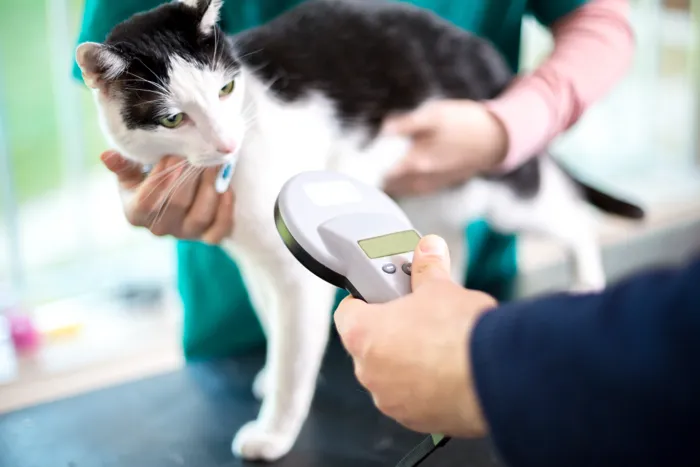
A veterinarian or veterinary professional inserts the microchip just beneath the skin, typically between the shoulder blades. The chip is placed using a specialized needle and syringe designed specifically for microchip implantation.
The process usually involves:
- Scanning the microchip before placement
- Inserting the chip under the skin
- Scanning again afterward to confirm it is working properly
- Registering the chip with your contact information
The entire procedure often takes only a few minutes.
Does it hurt?
This is one of the most common questions cat owners ask.
For most cats, microchipping feels similar to receiving a routine vaccine or injection. The needle is slightly larger than a vaccine needle because of the chip size, but the procedure is very quick.
Most cats tolerate microchipping well while fully awake.
Some owners choose to have the microchip placed during a spay or neuter procedure when their cat is already under anesthesia, but this is not required.
If you have concerns about safety, check out our guide on whether microchipping is safe for cats.
Why indoor cats need microchips too
Many owners assume microchips are only necessary for outdoor cats.
The reality is that indoor cats can become lost as well.
Consider how easily a cat might:
- Slip through an open door
- Escape during a move
- Get out during a storm or emergency
- Push through a damaged screen window
Cats that are unfamiliar with the outdoors often become frightened and may struggle to find their way back home.
A microchip provides an extra layer of protection if the unexpected happens.
Read more on why microchipping your pet is important to see how permanent identification helps bring lost pets home.
Microchip vs collar tag
This is not an either-or decision.
The best protection comes from using both a collar tag and a microchip.
Collar tags
- Easy to see
- Provide immediate contact information
- Can break, fall off, or become damaged
Microchips
- Permanent identification
- Cannot be removed accidentally
- Require a scanner to read
Having both greatly increases the chances of being reunited with a lost pet.
The step many owners forget
Getting the microchip implanted is only part of the process.
You also need to register the chip and keep your information updated.
If you move or change your phone number, be sure to update your registration information. An unregistered microchip is much less useful because shelters and veterinary clinics will not be able to connect the identification number to you.
How microchips help lost cats get home
When a lost cat is brought to a veterinary clinic or shelter, staff routinely scan for a microchip.
If a chip is detected:
- The identification number is retrieved
- The registration database is checked
- Owner contact information is located
- Reunification efforts begin
Microchipped cats are significantly more likely to be reunited with their families than cats without permanent identification.
What if you adopt a cat that already has a microchip?
This is more common than many people realize.
If you adopt a cat from a shelter, rescue, or previous owner, it is important to verify that the microchip information has been updated.
Ownership information does not automatically transfer when a cat changes homes.
If your cat already has a microchip, learn more about how to transfer microchip ownership so the registration information is linked to you.
Additional benefits of microchipping
Microchips do more than help recover lost pets. They can also be important for:
- Travel requirements
- International relocation
- Rabies documentation
- Pet identification during emergencies
Some pet doors and feeding systems can even be programmed to recognize your cat’s microchip.
A simple step that can make a big difference
Microchipping is quick, safe, and provides lifelong identification for your cat. While no one expects their pet to become lost, being prepared can make all the difference if it ever happens.
Our team can answer your questions, implant a microchip, and help make sure your registration information is set up correctly.
Schedule an appointment today to give your cat an extra layer of protection.